TL;DR
- Transparency has three facets (NIST): model transparency, provenance tracking, synthetic-content detection. Detecting AI text serves authentication, observation of AI usage and separating training data; the EU AI Act (Art. 50) will require machine-readable marking.
- Post-hoc detection: word frequencies (“delve”) reveal AI use at scale; perplexity alone fails (prompts, memorized text); Binoculars divides the perplexity by a cross-perplexity between two related models; trained detectors (Pangram) use synthetic mirrors and hard-negative mining.
- KGW watermark: a keyed hash of the previous tokens splits the vocabulary into green () and red; add to the green logits. Detection is a one-sample z-test on the number of green tokens. trades detection strength against quality.
- Alternatives: Aaronson’s Gumbel scheme is distortion-free per token; Christ-Gunn-Zamir watermarks are cryptographically undetectable, but every watermark needs entropy.
- Attacks: paraphrasing (signal survives with more tokens), ciphers, oracle best-of-N, copy-paste mixing, watermark stealing (→ scrubbing and spoofing).
- Future: the volume argument (watermarking by default makes most machine text detectable), trivial Unicode marks, and the reverse approach: proving content is human (C2PA, personhood credentials).
Exam relevance
3 questions from this lecture. Mock exam question: Binoculars uses an “observer” and a “performer”. Why does it compare two perplexities instead of thresholding one? (answer in Detecting Machine Text Using Binoculars). Likely topics: why perplexity alone fails, how KGW embeds and detects the watermark (z-score formula), the δ/γ trade-off, KGW vs. Aaronson vs. undetectable watermarks, the attacks and what spoofing means, the volume argument. Mini-Project 2, Part 2 implements KGW.
Overview: I. Why transparency, II. Post-hoc detection, III. Watermarking, IV. Attacks, V. The future of provenance.
Topics for Today
Slide 2
| Part | Topics |
|---|---|
| I · Why transparency? | three-pillar framing (NIST), the case for detection |
| II · Post-hoc detection | word cues, perplexity measures, Binoculars, modern detectors |
| III · Watermarking | KGW green/red list, detection statistics, hash schemes, undetectable watermarks |
| IV · Attacks | paraphrase, cipher, oracle, copy-paste, watermark stealing, distillation |
| V · The future | the volume argument, Unicode, reverse watermarks and cryptographic human attestation |
Mini-Project 2, Part 2 implements the KGW green-list watermark from Part III.
Part I: Why Transparency?
Slide 3
What Is AI Transparency?
Slide 4
Three facets, following NIST AI 100-4 (2024):
| Facet | What it is |
|---|---|
| Model transparency | disclosure about the system: weights, training data, methodology, evaluations, governance |
| Provenance data tracking | a chain of custody attached to an artifact: signed metadata, capture-device signatures, edit history |
| Synthetic content detection | an externally verifiable attribution of content as synthetic |
This lecture is about the third facet (and, at the end, provenance). Training-data transparency follows in Lecture 6.
Why Detect AI-Generated Text?
Slides 5-6
| Goal | What it means |
|---|---|
| Authentication | authenticate non-human communication; attribute text to machine writers; rate how much human effort went into a piece of data |
| Observation | observe AI usage at scale: where, how fast and in which domains LLM text is replacing human text (Liang et al., 2024) |
| Separation | separate human-written from machine-written data for future training runs |
Detection also matters for the societal risks of Lecture 1: if nobody can tell who wrote what, human influence erodes quietly (Kulveit et al., “Gradual Disempowerment”, 2025).
The Policy Landscape
Slide 7
EU AI Act, Article 50(2)
Providers of AI systems generating synthetic audio, image, video or text content shall ensure that the outputs are marked in a machine-readable format and detectable as artificially generated or manipulated. Providers shall ensure their technical solutions are effective, interoperable, robust and reliable, as far as technically feasible.
Regulation (EU) 2024/1689, in force 1 Aug 2024; Art. 50 enforceable from 2 Aug 2026; fines up to €15M or 3% of worldwide turnover (Art. 50). The EU Code of Practice on AI-generated content (first draft Dec 2025, final June 2026) suggests combining metadata + invisible watermarking + visible disclosure.
| Jurisdiction | Status |
|---|---|
| US federal | EO 14110 (Biden, Oct 2023) revoked on 20 Jan 2025, replaced by the deregulatory EO 14179; NIST AI 100-4 remains voluntary guidance |
| California SB 942 | image, video, audio only (text excluded); AB 853 (Oct 2025) delayed the start to 2 Aug 2026 |
| China | labeling measures for AI-generated content (Mar 2025, effective 1 Sep 2025) + national standard GB 45438-2025 |
Part II: Post-hoc Detection
Slide 8
Disambiguation
Slide 9
| Task | Question | Signals |
|---|---|---|
| LLM-text detection | did a language model write this text? | token statistics, log-prob curvature, stylistic regularities, embedded watermark |
| Misinformation detection | is this claim true or false? | source consistency, world knowledge, fact-check databases |
| Deepfake detection | was this image, audio or video synthesized or manipulated? | pixel artifacts, frequency-domain residues, inverse generation |
Trap
“AI-written” and “false” are different questions. A detector for LLM text says nothing about whether the text is true.
”I Can Tell Your Text Is Machine-Generated…”
Slide 10
In practice, most frontier models are surprisingly visible in their speech patterns (examples as of May 2026):
- em dashes, especially in “not THIS but THAT” constructions,
- vocabulary shifts that overuse certain phrases,
- constructions like “Judge [concept] by [term], not binary broken / not broken”, catchy fragments like “Why it breaks:”,
- meta-narration that incorporates the user’s feedback,
- text written to sound convincing, but without substance.
Word-Frequency Analysis
Slide 11
A frequency analysis of 15M PubMed abstracts (2010 to 2024) finds marker words spiking after 2022: delves, intricate, tapestry, underscore, meticulous, commendable, showcase, realm, paramount, garnered, navigating. Liang et al., Nat. Hum. Behav. 2025 estimate that at least 13.5% of biomedical abstracts and up to 17.5% of CS papers carry LLM word-frequency signatures (compared with control words like “ebola”, “pandemic”). Why these words: Liang et al., “Why Does ChatGPT ‘Delve’ So Much?”, COLING 2025.
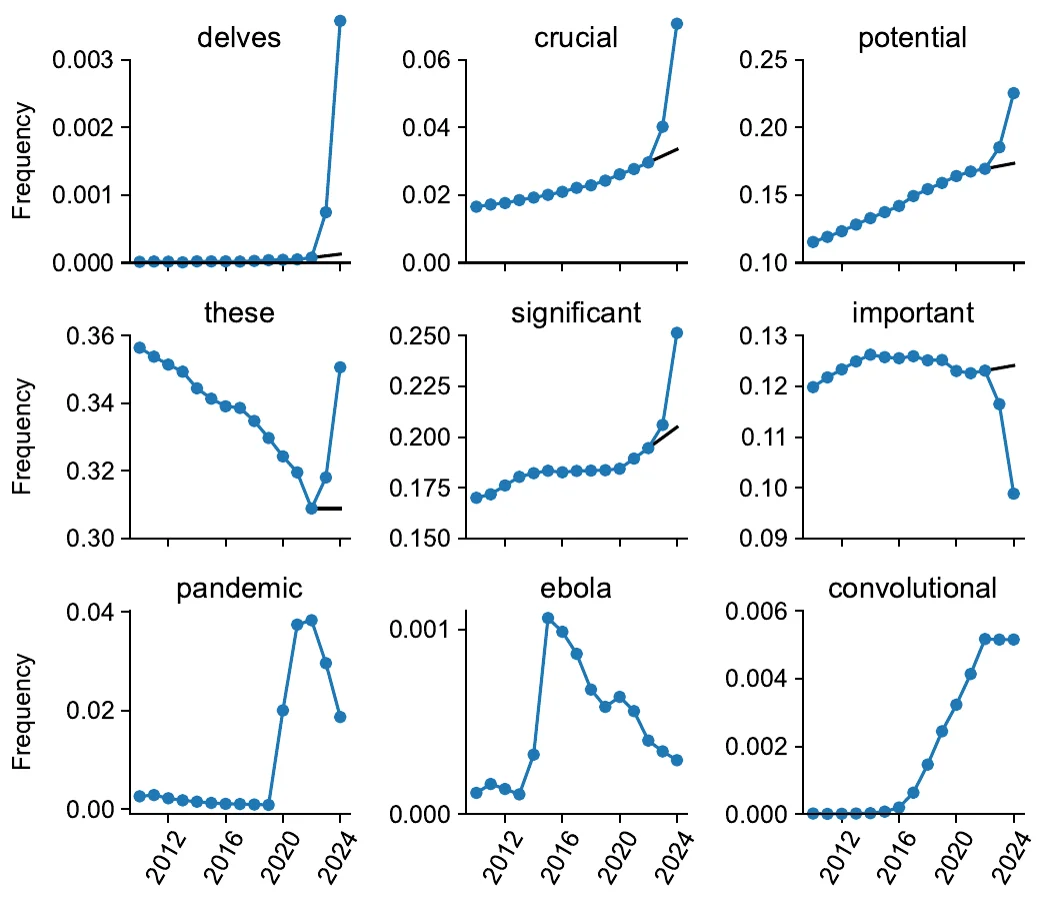
Mini-Project 2, Part 2.1 experiments with vocabulary shifts in Qwen3-4B. This works at scale (estimating the share of AI text in a corpus), not for judging a single document.
Detector Baselines: Perplexity
Slide 12
A language model assigns high probability to text it produces itself. So machine text from the same (or a related) model has low perplexity, human text has normal perplexity.
Perplexity
Failure modes:
- The prompt is missing. A prompt can produce a response that has high perplexity without the prompt. “Write a few sentences about a capybara that is an astrophysicist” gives “Dr. Capy Cosmos, a capybara unlike any other, astounded the scientific community…”: surprising text, so high perplexity, even though a model wrote it.
- Memorized text has low perplexity for all models. “Mr. and Mrs. Dursley of number four, Privet Drive, were proud to say that they were perfectly normal…” is human-written but looks machine-like.
Detecting Machine Text Using Binoculars
Slide 13
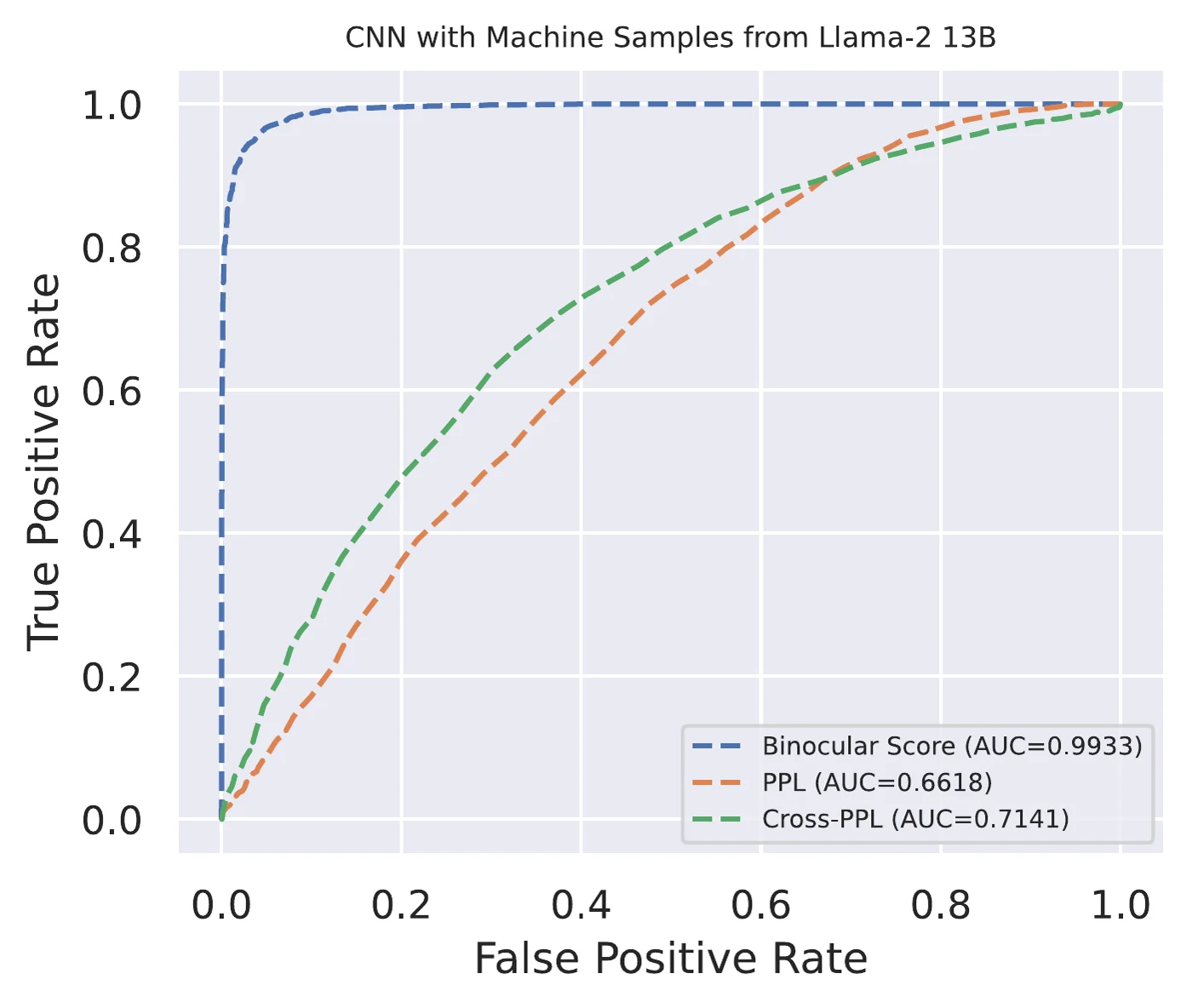
The perplexity problem can be avoided by looking at relative perplexity from two closely related models: = observer (Falcon-7B-Instruct), = performer (Falcon-7B) (Hans et al., “Spotting LLMs With Binoculars”, ICML 2024).
Cross-perplexity and the Binoculars score
The per-token cross-entropy between the two models’ next-token distributions: how surprised is, on average, by what would predict.
One threshold: → machine. Human text lies above, model-written text has anomalously low scores.
Why a ratio?
The perplexity of a text depends a lot on how surprising the prompt and topic are. The cross-perplexity measures how surprising the text is for a language model in general, i.e. the baseline for this kind of content. Dividing cancels the prompt- and topic-driven part: the capybara text is surprising, but equally surprising to both models, so the ratio is still low.
Mock exam: why two perplexities?
Neither model’s perplexity alone separates human from machine text, because perplexity also varies with the prompt and topic. Their ratio cancels this variation, so genuinely model-written text shows an anomalously low relative perplexity, while human text does not.
See AI Text Detection.
Modern Industrial Detectors
Slide 14
Strong detectors are trained classifiers, and the design of the training data matters most. Pangram’s recipe: synthetic mirrors with iterated hard-negative mining:
- Mirror prompts: for each human document, build a prompt that matches topic, length and register, so the AI counterpart is very close (e.g. “Write an -star review for around words long”).
- Iterate: train , run it on the human pool, collect the false positives, generate matching mirrors for them, retrain ; repeat until it plateaus.
- Scale the data: include all known “humanizers” and evasion tools.
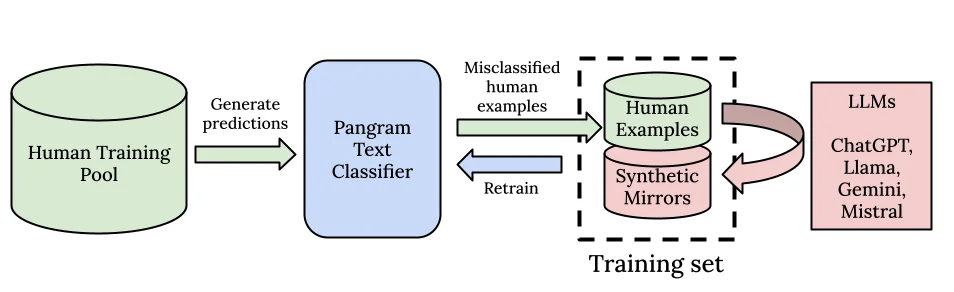
Sources: Emi & Spero, Pangram technical report, 2024; Masrour, Emi & Spero, DAMAGE, COLING 2025; a Pangram study estimates 21% of ICLR 2026 reviews are AI-generated.
Intuition
Hard-negative mining is the same trick as in adversarial training: keep finding the examples the model gets wrong (here: human texts flagged as AI) and train on close counterexamples. It drives down the false-positive rate, which is what matters when you accuse a person.
Part III: Watermarking Text
Slide 15
What Is Watermarking, and Why?
Slides 16-17
Watermarking
Embedding hidden signals into (machine-)generated content. Watermarking makes the detection of generated content tractable: instead of guessing from style, you run a statistical test for a signal you put there yourself. See Watermarking.
What Do We Want Out of Watermarks?
Slide 18
Desiderata:
- A strong signal in any contiguous portion of generated text.
- Detection is cheap and does not need model access.
- No noticeable effect on language quality.
- Hard to remove without significantly changing the text.
- Detection gives a calibrated statistical confidence (a p-value).
Reminder: Normal Next-Token Prediction
Slide 19
Embedding the Watermark: Softly Bias the Logits
Slide 20
A pseudo-random function of a secret key and the previous tokens splits the vocabulary into a green list (a fraction of ) and a red list. Add to the green logits before the softmax (Kirchenbauer et al., ICML 2023, §3):
Soft red/green watermark (KGW)
= logit of token at step . Hyperparameters: = green-list fraction, = green-logit bias, = hash window over the previous tokens.
Intuition
It is a soft bias: when the model is confident (one token has most of the probability), adding to other tokens barely changes the choice, so quality is preserved. Where several continuations are plausible, the green ones win more often, and that leaves a statistical trace.
Detecting the Watermark: a One-Sample z-Test
Slide 21
The detector only needs the key and the text: re-hash every position, count the green tokens and test whether there are too many.
z-test
= number of tokens, = number of green tokens, = expected green fraction without watermark. Read the p-value off the standard normal tail. For small it is more exact to evaluate the binomial tail (§4).
Worked example
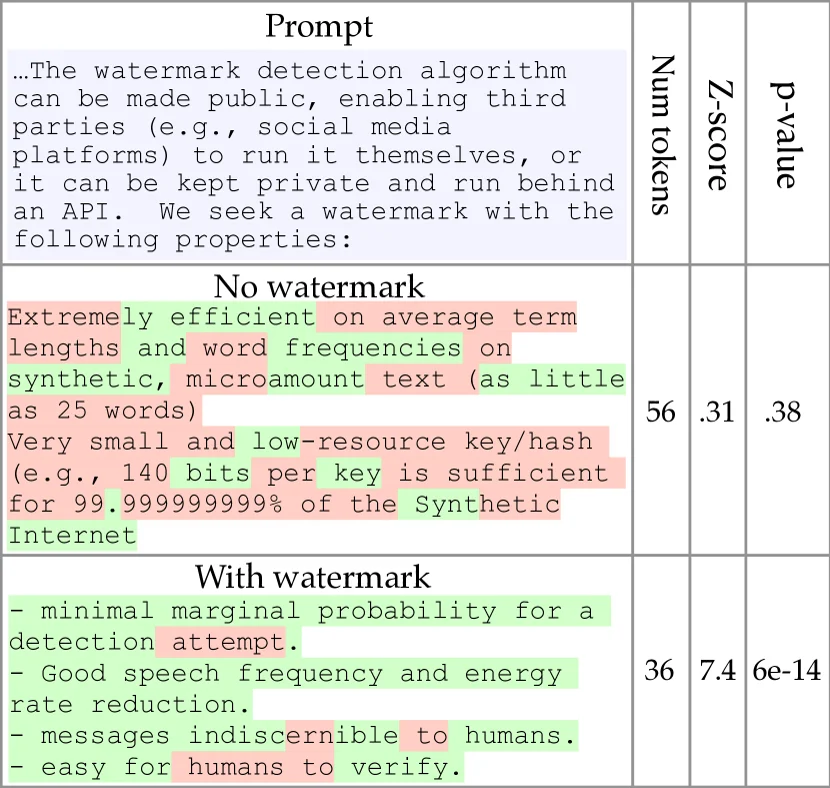
, tokens, green: , far above the usual threshold of 4. The signal grows like : with the same green fraction, four times more tokens double .
Detection Example
Slide 22
The same detector (, , key 2026, SHA-256) on two passages; the watermarked one was generated by Qwen2.5-0.5B-Instruct with .
The δ Knob: Detection Strength vs. Quality
Slide 23
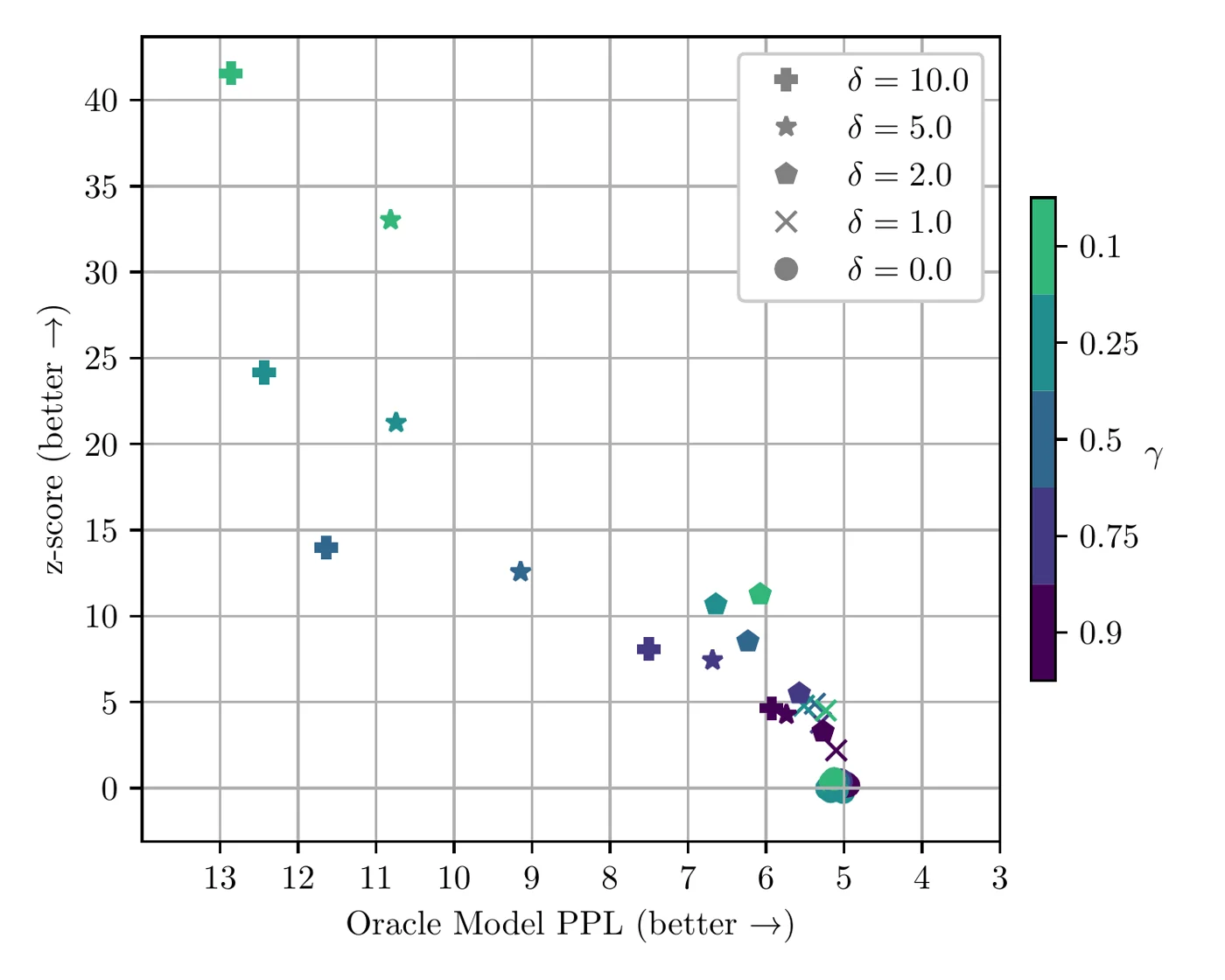
| Setting | Effect |
|---|---|
| no watermark: z ≈ 0, perplexity at the model’s baseline | |
| detection at z ≈ 4 on most generations, perplexity ~5.4 (negligible cost) | |
| , | AUROC 0.998, perplexity 6.2; default for the mini-project |
| detection saturates, but perplexity approaches 12: the text visibly degrades | |
| smaller | more signal per green token, but likely tokens get excluded, so perplexity rises |
Robust Variants of the PRF
Slide 24
The seed for the green/red split at position is a PRF of the previous tokens. Three ways to combine them (Kirchenbauer et al., “On the Reliability of Watermarks for Large Language Models”, ICLR 2024, §4.1):
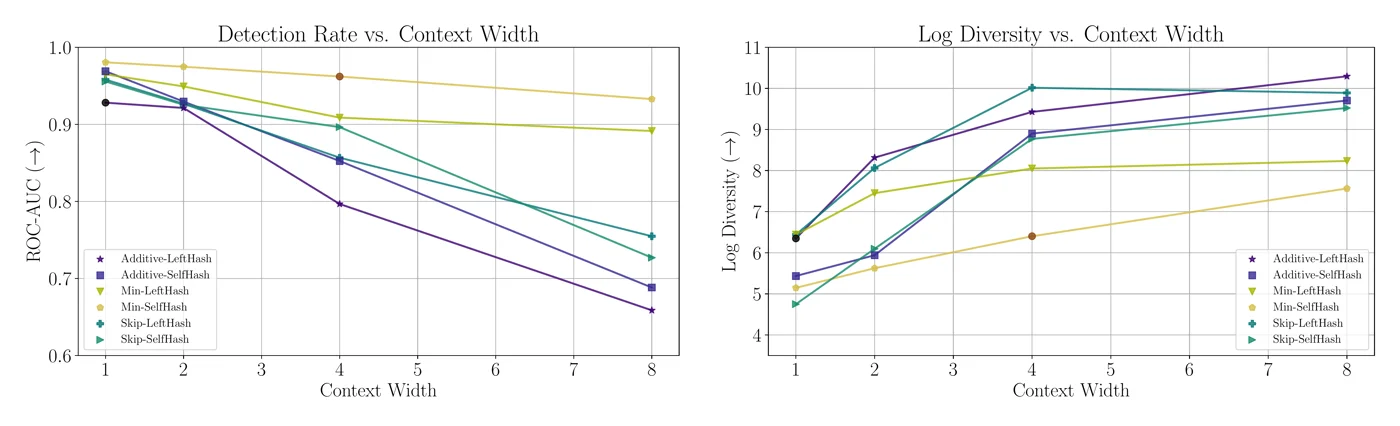
Intuition
A larger window makes the green list depend on more context, which is harder to learn for an attacker (see stealing below) and gives more varied text. But every edited token then destroys the green lists of following positions. “Min” is robust because changing one of the tokens often doesn’t change the minimum.
Alternatives: Aaronson’s Distortion-Free Gumbel Scheme
Slide 25
Watermarks must inject the signal somewhere in the sampling. KGW biases the distribution; the signal can also be put into the random draw of the sampler (Aaronson, 2022; Simons workshop slides, 2024; formalized by Kuditipudi, Thickstun, Hashimoto & Liang, “Robust Distortion-Free Watermarks”, 2023):
Gumbel-max watermark
Detection sums a score over the emitted tokens:
With the watermark, is stochastically larger; test with a one-sided p-value against the Gamma distribution.
If the were truly random, would pick token with probability exactly : sampling is unchanged. But the chosen tokens tend to have large , which the detector (knowing the key) can see.
| Aaronson | KGW | |
|---|---|---|
| Marginal distribution | exactly | shifted towards green |
| Statistic | green count | |
| Test | Gamma | binomial |
| Distortion | none (in expectation) | yes |
| Repeated context | repeats the same output | new random draw |
Cryptographically Undetectable Watermarks
Slide 26
Undetectable watermark (Christ, Gunn & Zamir, COLT 2024)
A watermark is undetectable if no polynomial-time adversary with adaptive query access to the watermarked model can distinguish its outputs from the unwatermarked model with non-negligible advantage (paper).
One-bit construction: derive from a PRF; use with the inverse CDF of the next-token distribution to read off one bit; embed only at positions with enough empirical entropy, and pass low-entropy positions through unchanged.
This is strictly stronger than Aaronson: undetectability holds on the joint output distribution, so the key can’t be extracted from polynomially many queries, and spoofing is provably blocked. The same idea exists for images (Gunn, Zhao & Song, ICLR 2025).
| Scheme | Property |
|---|---|
| KGW | distortionary; can be resampled and combined with any sampler |
| Aaronson / Kuditipudi | distortion-free per token; leaks through repeated contexts |
| Christ-Gunn-Zamir | undetectable on the joint output; needs an entropy condition |
Entropy is unavoidable
Zero-entropy positions (copy-paste, code with one obvious next token) can’t carry a hidden bit without changing the output. CGZ formalize this as a hard limit: low-entropy text can’t be watermarked.
Part IV: Attacks on Watermarks
Slide 27
What Could Happen to Watermarked Text in Daily Use?
Slide 28
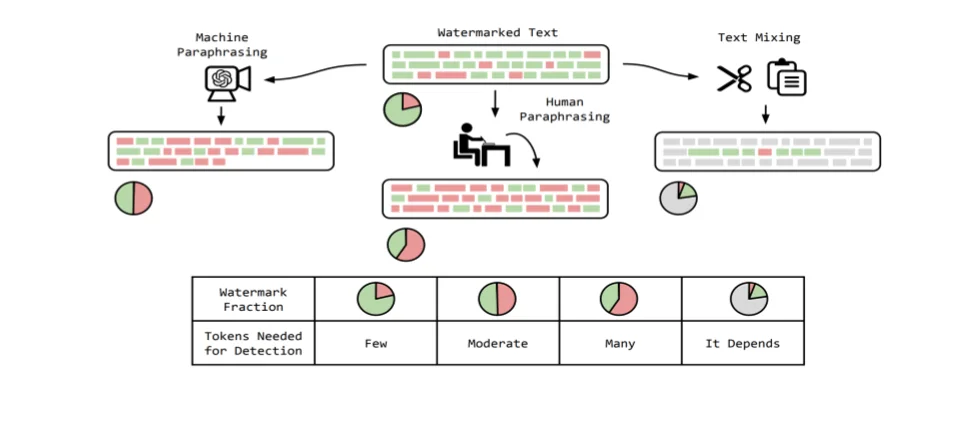
Machine Paraphrasing and Paraphrases
Slides 29-30
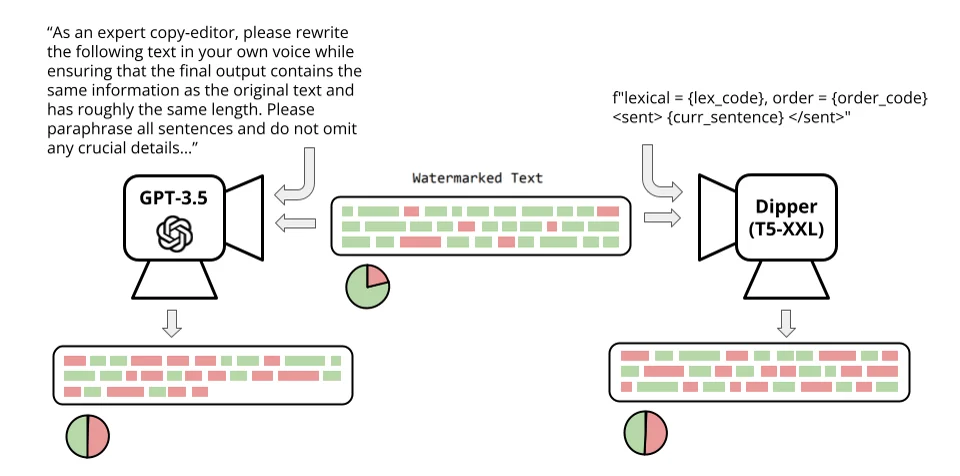
Tokens needed to reach (KGW2):
| Text | Tokens needed |
|---|---|
| unparaphrased | ~25 |
| GPT-3.5 paraphrase | ~150 to 300 |
| DIPPER (T5-XXL) | ~200 to 400 |
| strong human paraphrase | ~800 (at FPR = 10⁻⁵) |
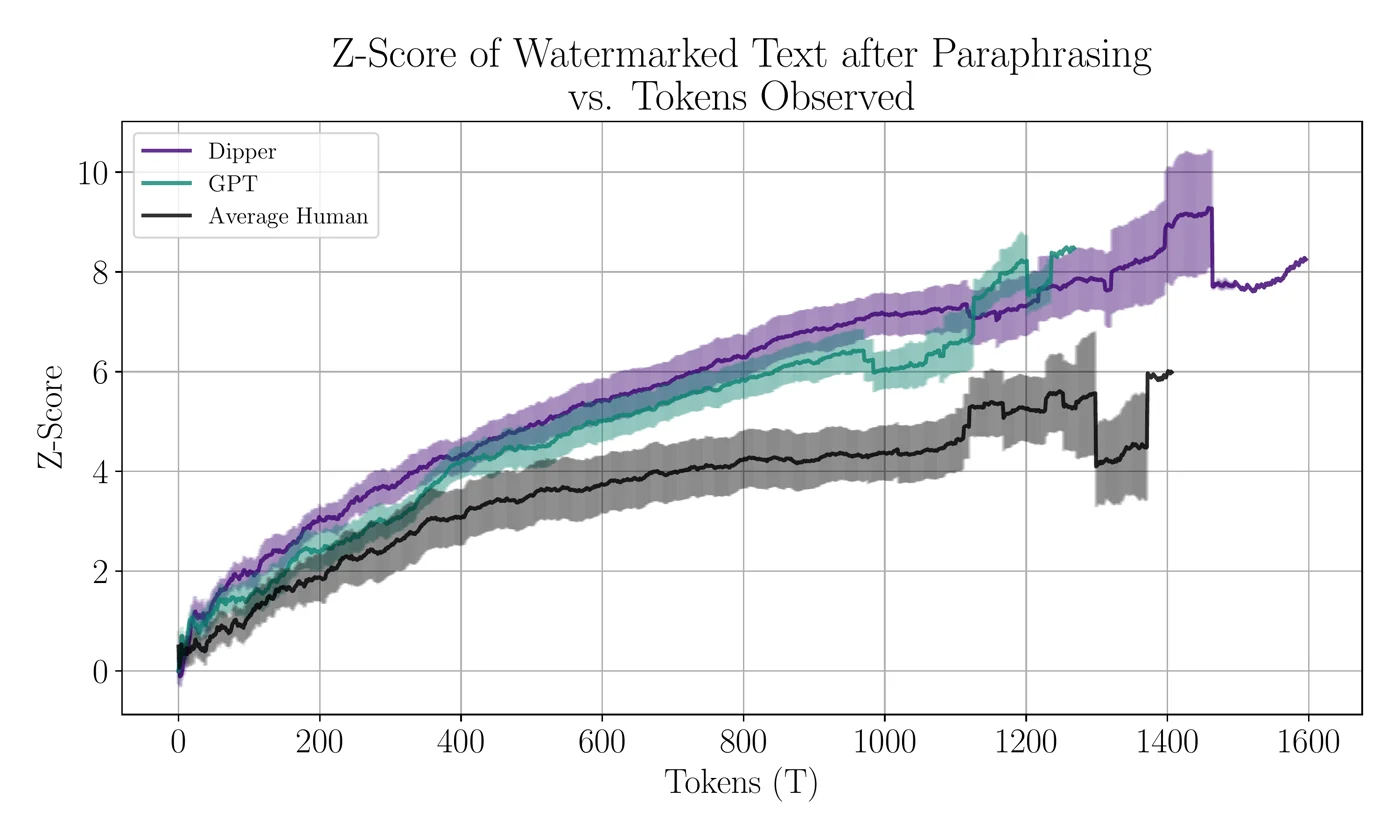
Longer text helps
Paraphrasing lowers the signal per token, but it rarely removes it completely. Because grows with , the surviving green tokens still add up once the text is long enough.
Adversarial Attack Surfaces
Slide 31
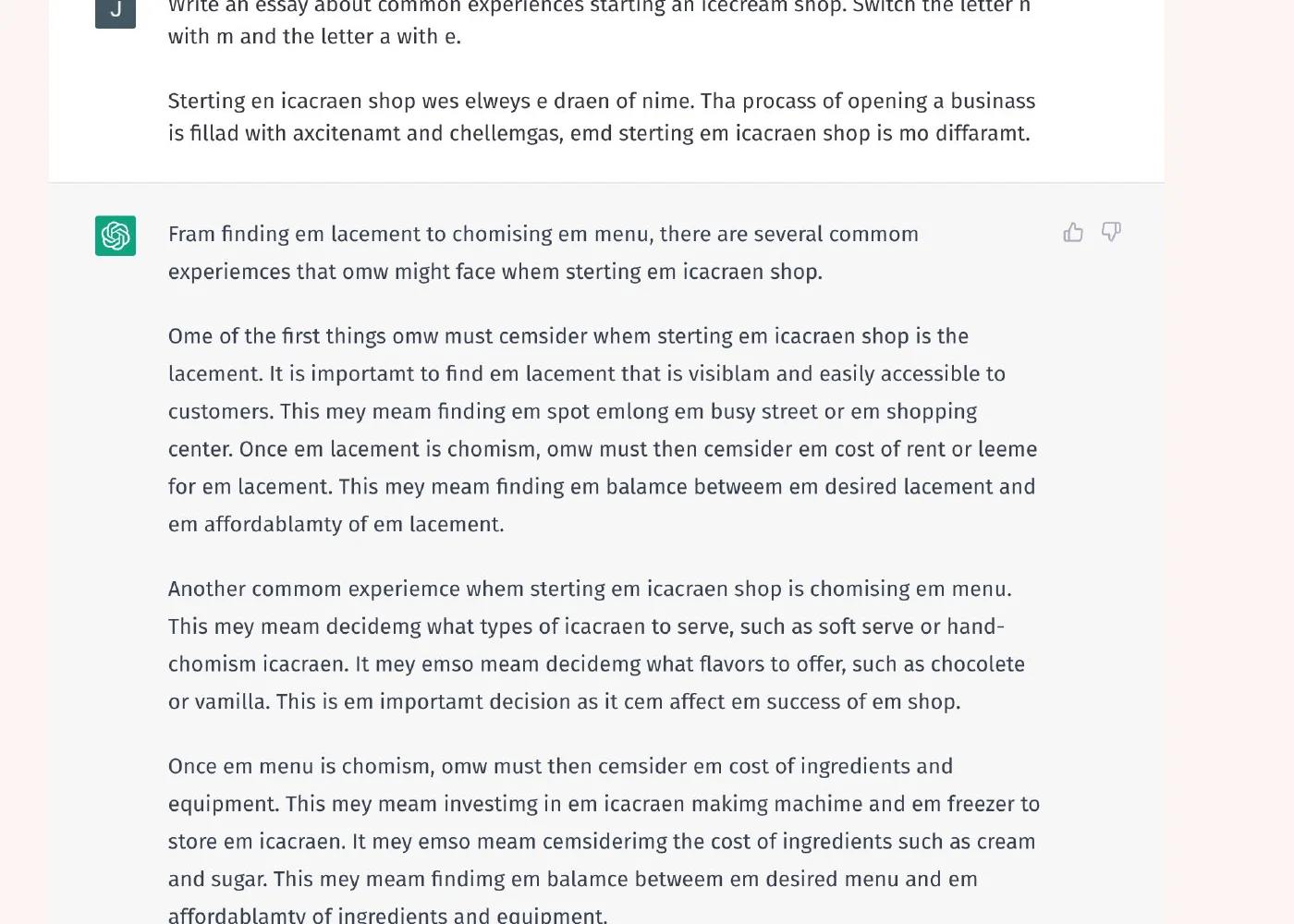
Three attacks from and around Zhang, Edelman, Francati, Venturi, Ateniese & Barak, “Watermarks in the Sand”, ICML 2024:
| Attack | How it works |
|---|---|
| Cipher | ask for the answer in base64, Chinese, or with “an emoji after every word”. The watermark is applied to the cipher text; after converting back, all n-grams are different, so the green lists no longer match |
| Oracle | a weak open model proposes answers, the watermarked strong model only judges them. Best-of-N approaches strong-model quality, with no watermark in the output |
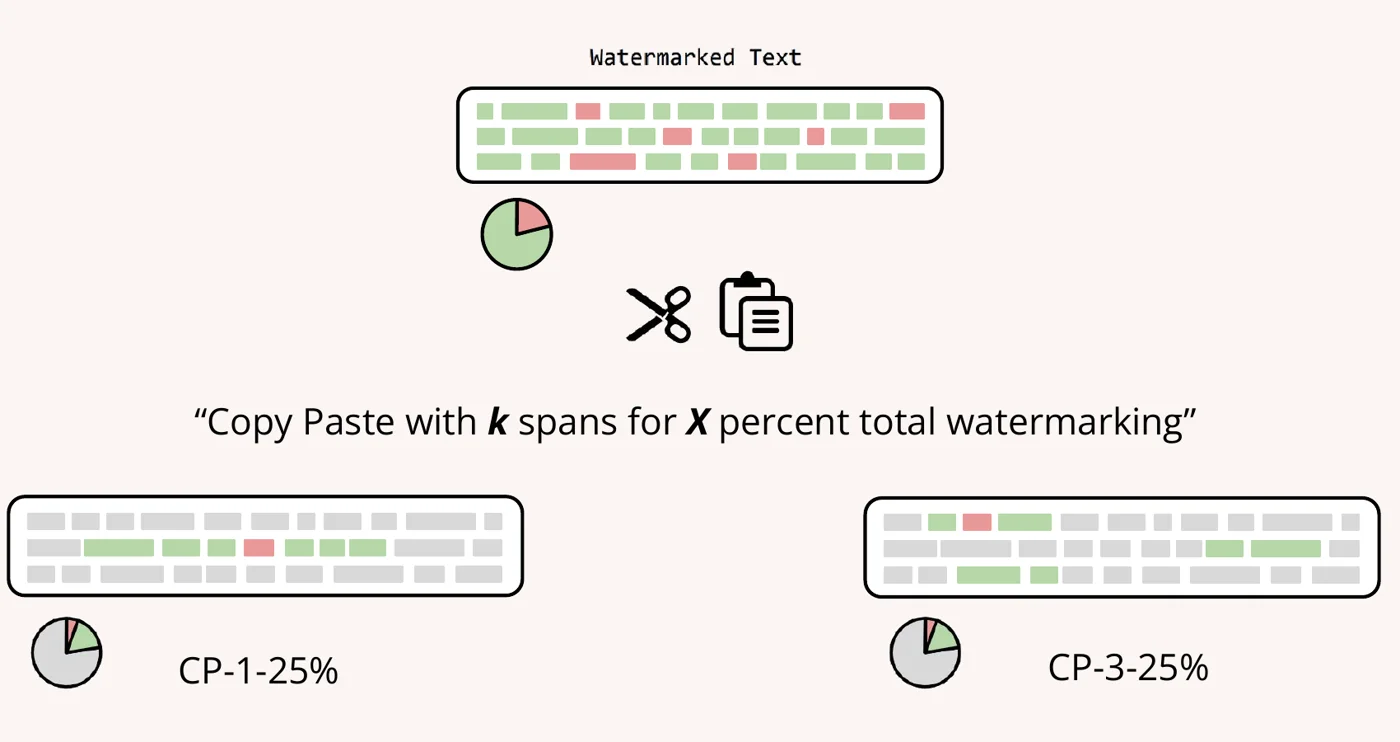
| Copy-paste mixing | paste watermarked spans into a longer human document. CP-- = spans that make up of the text. A single z-test over the whole text fails; the signal comes back with length |

Watermark Identification and Spoofing
Slide 32
Watermark stealing queries a deployed watermarked model and statistically recovers the green-list signature (Jovanović, Staab & Vechev, ICML 2024; Pang et al., 2024). With the green lists known, the attacker can:
- Scrub: write AI text that avoids the green list, so the detector misses it.
- Spoof: write text that hits the green list and looks human-written, so the detector falsely accuses someone.
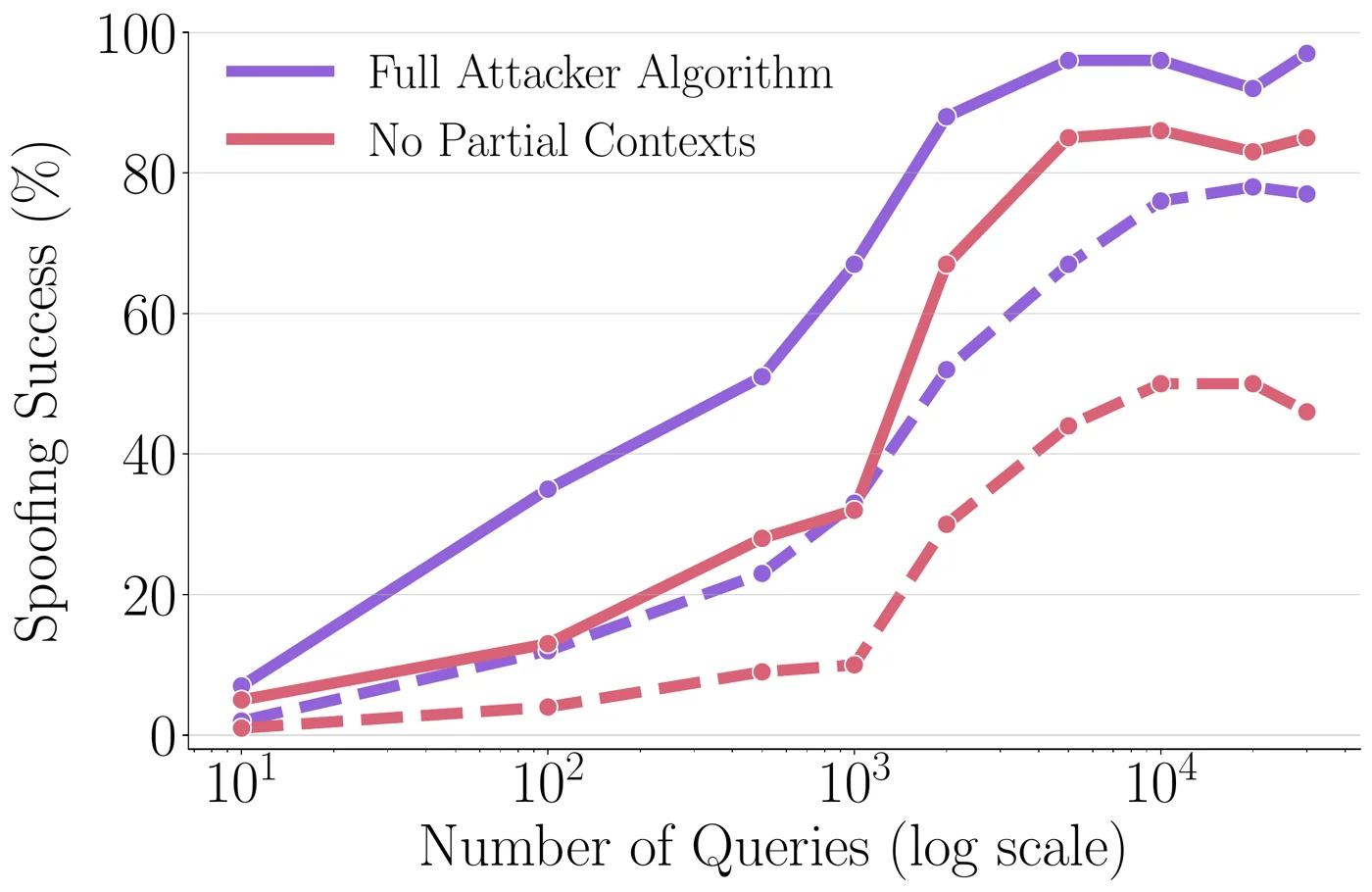
- Difficulty scales with : the number of watermarked n-grams grows like , but not all are needed.
- Spoofing risks: frame a model provider for text it did not produce; erode trust in the watermark detector itself.
- What blocks it: Christ-Gunn-Zamir undetectable schemes are robust against it by construction.
Part V: The Future of Provenance
Slide 33
Is Watermarking Worth It? The Volume Argument
Slide 34
The volume argument
Without watermarking, everything machine-generated is hard to detect. With watermarking by default, all machine text is detectable, and only the attacked subset (paraphrased, removed) stays hard to detect, as before. Even a breakable watermark shrinks the unverifiable part enormously.
Unicode Watermarks
Slide 35
Whitemark replaces the ASCII space U+0020 with one of ~22 visually identical Unicode whitespace characters (U+2004 three-per-em, U+200B zero-width, …) and encodes one bit per whitespace. Variants for CJK glyph selectors and sub-pixel kerning exist (Variantmark, Printmark). Invisible, survives copy-paste (Sato, “Embarrassingly Simple Text Watermarks”, 2023). And it is defeated by one line:
re.sub(r"[-︀-️ -]", "", text) # strip the special whitespace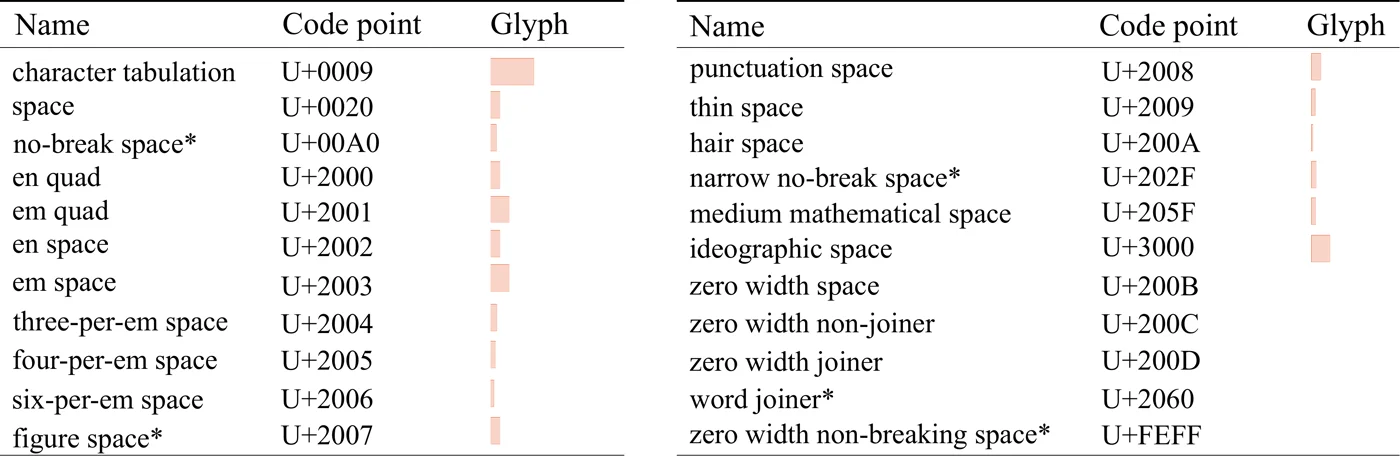
Unicode proposal L2/25-241 (Casper et al., Sep 2025) suggests two new code points, both looking like U+2060 WORD JOINER:
- TNCI (Training Non-Consent Indicator): authors mark text as not allowed for AI training.
- AGTI (AI-Generated Text Indicator): providers mark their output as machine-generated.
Default insertion: one per sentence at a random position; no bit encoding, no cryptographic binding. Status: earliest stage of review, not adopted.
The slide's point
If we want detection by default, and all watermarks are breakable anyway, why not use the simplest one?
The Reverse Approach: Proving Content Is Human
Slide 36
| C2PA / Content Credentials | Personhood credentials | |
|---|---|---|
| What | a signed CBOR manifest that binds the capture device, edits and the AI generation tool to a hash chain; verification = X.509 certificate + hash check (C2PA spec 2.2) | offline issuance ceremony, online zero-knowledge proof of unique personhood (Adler, Hitzig, Jain, Birhane, Buterin et al., 2024) |
| Deployed | Adobe Firefly, DALL·E + Sora, Leica M11-P, Samsung Galaxy S25; the EU AI Act Art. 50 may make it mandatory in late 2026 | extreme example: Worldcoin, an iris hash → Groth16 zk-SNARK (World ID) (privacy deep-dive; Buterin’s critique of biometric proof of personhood) |
| Side | provider side | user side |

Implemented correctly, zero-knowledge proofs can attest authorship or allowed attributes without leaking anything else. Composed, verified human + uncorrupted pipeline could guarantee attribution to humans: technically feasible, politically complicated.
Key Takeaways
Slide 37
| # | Takeaway |
|---|---|
| 1 | Detection is hard, but often doable. Long, unedited LLM text is essentially detectable (LLMs write in a distinctive style); short, paraphrased or adversarially humanized text is hard. |
| 2 | Watermarking turns detection into a tractable hypothesis test. Red/green watermarks slightly change the output distribution; others replace the sampling procedure. Modern watermarks are ideally undetectable. |
| 3 | Attacks go far beyond paraphrasing: ciphers, oracles, copy-paste mixing, key stealing and spoofing. |
| 4 | Transparency could also come from verification. Watermarks shrink the undetectable machine text; provenance and personhood credentials grow the verifiably human text. |
Summary
| Method | Needs | Strength | Weakness |
|---|---|---|---|
| Word frequencies | a corpus | shows AI use at scale | useless for one short text |
| Perplexity | one LM | simple | prompts, memorized text |
| Binoculars | two related LMs | zero-shot, one threshold | short or edited text |
| Trained detector (Pangram) | lots of mirrored data | low false positives | humanizers, distribution shift |
| KGW watermark | the key, cooperation of the provider | p-values, cheap detection | paraphrase, cipher, stealing/spoofing |
| Aaronson / CGZ | the key | distortion-free / undetectable | needs entropy |
Self-Test
Question cards (14)
What are the three facets of AI transparency, and why detect AI-generated text?
Answer
Model transparency (disclose weights, data, methods, evaluations), provenance tracking (signed chain of custody), synthetic-content detection (verifiable attribution as AI-generated). Detection serves authentication, observation of AI usage at scale, and separating human from machine data for future training.
How does perplexity-based detection work, and why does it fail?
Answer
Text generated by a model (or a related one) has low perplexity under it, human text normal perplexity. It fails because perplexity depends on the missing prompt (an unusual prompt yields high-perplexity machine text) and because memorized human text has low perplexity for all models.
Binoculars uses an observer and a performer. Why does it compare two perplexities instead of thresholding one?
Answer
Neither perplexity alone separates human from machine text, since it varies with prompt and topic (AUC 0.66 and 0.71). The ratio B = log PPL / log X-PPL normalizes by how surprising the text is for a language model in general, cancelling the prompt- and topic-driven part; model-written text then shows an anomalously low ratio (AUC 0.99), human text does not.
How are strong trained detectors like Pangram built?
Answer
For each human document, generate a synthetic mirror that matches topic, length and register. Train, find the human texts that are falsely flagged, generate mirrors for them and retrain, until it plateaus; include known humanizers. This iterated hard-negative mining keeps the false-positive rate low.
How does the KGW watermark change generation?
Answer
A PRF of a secret key and the previous k tokens splits the vocabulary into a green list (fraction γ) and a red list. δ is added to the green logits before the softmax, so green tokens become more likely without being forced; where the model is confident the choice barely changes.
How is a KGW watermark detected? Give the formula.
Answer
Recompute the green lists with the key, count green tokens |s|_G among T, and compute z = (|s|_G − γT)/√(Tγ(1 − γ)). A large z (e.g. > 4) means far more green tokens than expected without watermark; the p-value comes from the normal tail, or the exact binomial for short texts. No model access is needed.
What do δ and γ trade off?
Answer
A larger δ gives stronger detection but lower quality: δ = 2, γ = 0.5 reaches AUROC 0.998 at perplexity 6.2, δ = 10 saturates detection but pushes perplexity to ~12. A smaller γ gives more signal per green token but excludes likely tokens more often, which raises perplexity.
Compare KGW, Aaronson's Gumbel scheme and Christ-Gunn-Zamir watermarks.
Answer
KGW biases the distribution towards green tokens and tests the green count (binomial); it distorts the output. Aaronson picks argmax r_v^{1/p_v} with PRF values r_v, so each token keeps its exact probability, and tests a Gamma-distributed score; repeated contexts give repeated outputs. CGZ embeds bits via PRF and inverse CDF only at high-entropy positions and is cryptographically undetectable on the joint output, which also blocks spoofing.
Why is entropy unavoidable for watermarking?
Answer
A watermark must influence a choice. At zero-entropy positions (copy-paste, code with one obvious next token) there is no choice to influence without changing the output, so no hidden bit fits there. Low-entropy text can’t be reliably watermarked.
How does paraphrasing affect a watermark, and why does detection still work for long texts?
Answer
Paraphrasing replaces many tokens, so fewer are green and the signal per token drops: z = 4 needs ~25 tokens unparaphrased, ~150 to 300 after GPT-3.5, ~800 after a strong human paraphrase. Some green tokens survive, and since z grows like √T, long enough text is still detected.
Explain the cipher, oracle and copy-paste attacks.
Answer
Cipher: the model writes in a transformed form (base64, emoji after every word); converting back changes all n-grams, so the green lists no longer match. Oracle: a weak open model generates, the watermarked model only judges, so the output carries no watermark. Copy-paste: watermarked spans are diluted in human text, so one global z-test fails, though the signal returns with length.
What is watermark stealing, and what is the difference between scrubbing and spoofing?
Answer
Querying a watermarked model (~10⁴ queries, ~$50 for k = 1) lets an attacker estimate the green lists statistically. Scrubbing then avoids green tokens so AI text goes undetected; spoofing uses green tokens so human-looking text is falsely flagged as model output, framing the provider or undermining trust in the detector.
What is the volume argument, and why use even a simple Unicode watermark?
Answer
As machine text comes to dominate the web, without watermarks all of it is hard to detect. With watermarking by default, only the attacked subset stays hard to detect, as before. So even a breakable mark (Unicode whitespace, one regex removes it) makes most machine text detectable by default.
How do C2PA and personhood credentials reverse the detection problem?
Answer
Instead of detecting AI text, they verify human content. C2PA binds capture device, edits and AI tools to a signed hash chain (provider side); personhood credentials prove unique human authorship with zero-knowledge proofs (user side). Together they could attribute content to verified humans: technically feasible, politically complicated.
Multiple Choice
Multiple choice (5)
γ = 0.5, T = 100 tokens, 70 of them green. What is the z-score?
2
4
7
20
Explanation
z = (70 − 50)/√(100 · 0.5 · 0.5) = 20/5 = 4, a clear detection.
Why does Binoculars divide by the cross-perplexity?
To make the detector faster.
To cancel the prompt- and topic-driven part of perplexity.
To add a watermark to the text.
Because the observer model has no perplexity.
Explanation
Perplexity alone mixes “written by a model” with “surprising content”. The cross-perplexity measures the expected surprise for this content, so the ratio isolates the first part.
Which property does the Christ-Gunn-Zamir watermark have that KGW lacks?
It works on zero-entropy text.
It survives any paraphrase.
Its outputs are computationally indistinguishable from unwatermarked outputs, which blocks spoofing.
It needs no secret key.
Explanation
CGZ is undetectable on the joint output distribution, so the key can’t be learned from queries. It still needs entropy and a key, and heavy paraphrasing still hurts.
An attacker writes human-looking text full of green tokens so that the detector blames the model provider. What is this?
scrubbing
spoofing
a cipher attack
an oracle attack
Explanation
Scrubbing hides AI text from the detector; spoofing makes the detector fire on text the model did not write. Both need a stolen green-list signature.
What happens to KGW detection when δ is raised from 2 to 10?
Detection gets weaker and quality better.
Detection saturates, but perplexity rises to ~12 and the text degrades.
Nothing changes, only γ matters.
The watermark becomes undetectable.
Explanation
δ = 2, γ = 0.5 already gives AUROC 0.998 at perplexity 6.2; more bias mostly costs quality.
References
All sources cited on the slides, in slide order (30 entries)
Related
- Previous: Lecture 4: Open-Weight Safety · Next: Lecture 6: Data Privacy and Memorization · Course: Overview
- Exam and reference: Exam Structure · Study Plan · Formula Sheet · Glossary
- Concepts: Watermarking, AI Text Detection, Content Provenance, Decoding and Sampling
- The watermark was first shown in Lecture 1; sampling and logits in Lecture 2.